The Charming Rebecca Ora, Artist & Provocateur, was ready to assist visitors at the Super Pop-Up information kiosk.
Sunday, November 22, 2009
Artist Jay Dion presents a wall of Porcelain vessels cast from the forms of tin cans. Dion offers an exchange: one of his sculptures for a can of food brought in by the visitor. Swap by swap the wall of pristine artist multiples is replaced with the colorful labels of canned corn, condensed milk, cranberry sauce... just in time for Thanksgiving.
Labels:
art exchange,
cans,
Jay Dion,
social practice,
Super Pop-up Shop
Saturday, November 21, 2009
Friday, November 20, 2009
Electronic Skin Tattoos
Okay. this is weird.
Phillips is developing this technology to implant microchips embedded in silk fibers into the human skin so that the skin becomes a screen.
One of the uses of this would be changeable tattoos that apparently are stimulated by desire... just in case you couldn't tell you were turned on? -- After all, why pay attention to your partner during sex when you can just read the bulletin on their skin... for anyone who pays attention we already emit bulletins...
More likely this technology is being developed for devious military reasons. I read an article somewhere in the last couple of years that talked about making clothing that was screen-like and could match the visuals of the environment around it... the ultimate camouflage... this kind of technology could make the wearer virtually invisible, just a ghost, shimmer, or static, just like in the Predator movies...
So maybe they're cloning human/robots who will be virtually naked except for their skinscreen which can shift or transform to hide them in the environment, or maybe the military will learn the techniques of butterfly display and exhibit monstrous visages on the skin of their new stealthy-soldiers to terrorize communities... or maybe they'll display hypnotic patterns and put adversaries into suggestive trances...
Yes, I have a good imagination.... but if there is one thing I've learned over the years... if I can imagine it the odds are somebody else with the means, and way less of a conscience, has already made it a reality...
Makes me want to pull a Thoreau
Anyway. Here's the Article and Creepy video:
Monday, October 19, 2009
Wednesday, October 14, 2009
This 'Strangeness'
" This 'strangeness' is 'strange' because reality is so fucking extraordinary, and strange too because most of us try to live without strangeness, and construct something called the 'ordinary' which never existed. Actually, the strangeness is so ordinary as to be quite natural. The strangeness is wonder and what is wondered at is so wonderful that it is strange we do not wonder more."
-Peter Redgrove in a letter to William Malpas
from The Art of Richard Long
Labels:
Art,
Peter Redgrove,
Strangeness,
William Malpas,
Wonder
Monday, October 5, 2009
Wednesday, September 30, 2009
Window Shopping Through Time
Wandering through Echo Park, never been there before, headed to a bookshop, and we pass this storefront. 'Mart', 'Time-Travel', my friends continue on, but something grabs me. Everything about the facade (almost everything - I hadn't noticed the robot/caveman display yet) says 'quickie-mart', 'convenience store' but something is different... something else is going on here... some invisible force pulls me to the door. - Turns out this is one of Dave Eggers' storefronts that functions in conjunction with the writing centers he has set up for kids around the country. I had never heard of this one before, it was love at first browse. The place was brilliant. Filled with hourglasses, cans of mammoth meat, robot milk, donuts from 1985, and of course a selection of publications by the kids and by the organization.
Switch in context
The details really made it come alive, like this casually written sign suggesting that the visitor come back 'yesterday'.


This was one of my favorites. Shade in a bag. You buy the seed of a tree, go back in time, plant it and water it, then come back to the time where you began and there should be a nice lovely tree waiting for you to relax under it. Of course, realistically this scenario is fraught with all kinds of hiccups, what with the dangers that trees are subjected to these days, but the sentiment is lovely.
Labels:
826,
alt-retail,
Dave Eggers,
Echo Park,
robots and cavemen,
Souveniers,
Time Travel
Sunday, September 6, 2009
Saturday, September 5, 2009
Thursday, August 13, 2009
Writing As Material Practice
- Defining ‘Writing’: How do we know when writing is ‘writing’? Is this category appropriate for characterising past forms of graphical symbolic expression?
- Scribal Technology: How do materials, tools and technological choices relate to the expression and meaning of writing?
- Inscribed Object Worlds: How does the substance, surface, shape or size of an object inform the expression and meaning of writing thereon?
- Writing as Embodied Practice and Performance: How does the physical expression of writing inform physical and sensory engagements?
- Methodology: What practice- and materials-based methods can be developed for the study of past writing, from documentation during excavation, analysis, interpretation and publication, to teaching and learning?
Human Nature: Justice vs. Power
Noam Chomsky debates with Michel Foucault
Transcript, 1971
http://www.chomsky.info/debates/1971xxxx.htm
Transcript, 1971
http://www.chomsky.info/debates/1971xxxx.htm
Wednesday, August 12, 2009
Phenomenology
'As envisioned by Husserl, phenomenology is a method of philosophical inquiry that rejects the rationalist bias that has dominated Western thought since Plato in favor of a method of reflective attentiveness that discloses the individual’s “lived experience.” Loosely rooted in an epistemological device, with Sceptic roots, called epoché, Husserl’s method which entails the suspension of judgment while relying on the intuitive grasp of knowledge, free of presuppositions and intellectualizing. Sometimes depicted as the “science of experience,” the phenomenological method is rooted in intentionality, Husserl’s theory of consciousness (developed from Brentano). Intentionality represents an alternative to the representational theory of consciousness which holds that reality cannot be grasped directly because it is available only through perceptions of reality which are representations of it in the mind. Husserl countered that consciousness is not “in” the mind but rather conscious of something other than itself (the intentional object), whether the object is a substance or a figment of imagination (i.e. the real processes associated with and underlying the figment). Hence the phenomenological method relies on the description of phenomena as they are given to consciousness, in their immediacy.'
-from Wikipedia
more...
-from Wikipedia
more...
OrangeFlowerBlueWall
Tuesday, August 11, 2009
New Piece Sent To Auction In Vermont
The name of this piece is:

My tears dream of evaporating into a cloud so they can travel across the world and fall down upon your cheek some rainy day in Tuscany.
I made it last weekend for an auction that my friend Christy is hosting in Vermont. She's starting up a new artist studio collective and the auction is a fundraiser.
I consider the piece to be a sculpture, the frame being part of it.
I made the drawings in 2003 while I was studying in Tuscany... they are Italian clouds...
The important thing is the relationship between the image and the text. The space between them, and the intimacy. And this within the ordered system of the Arrangement and the Frame.
Monday, August 10, 2009
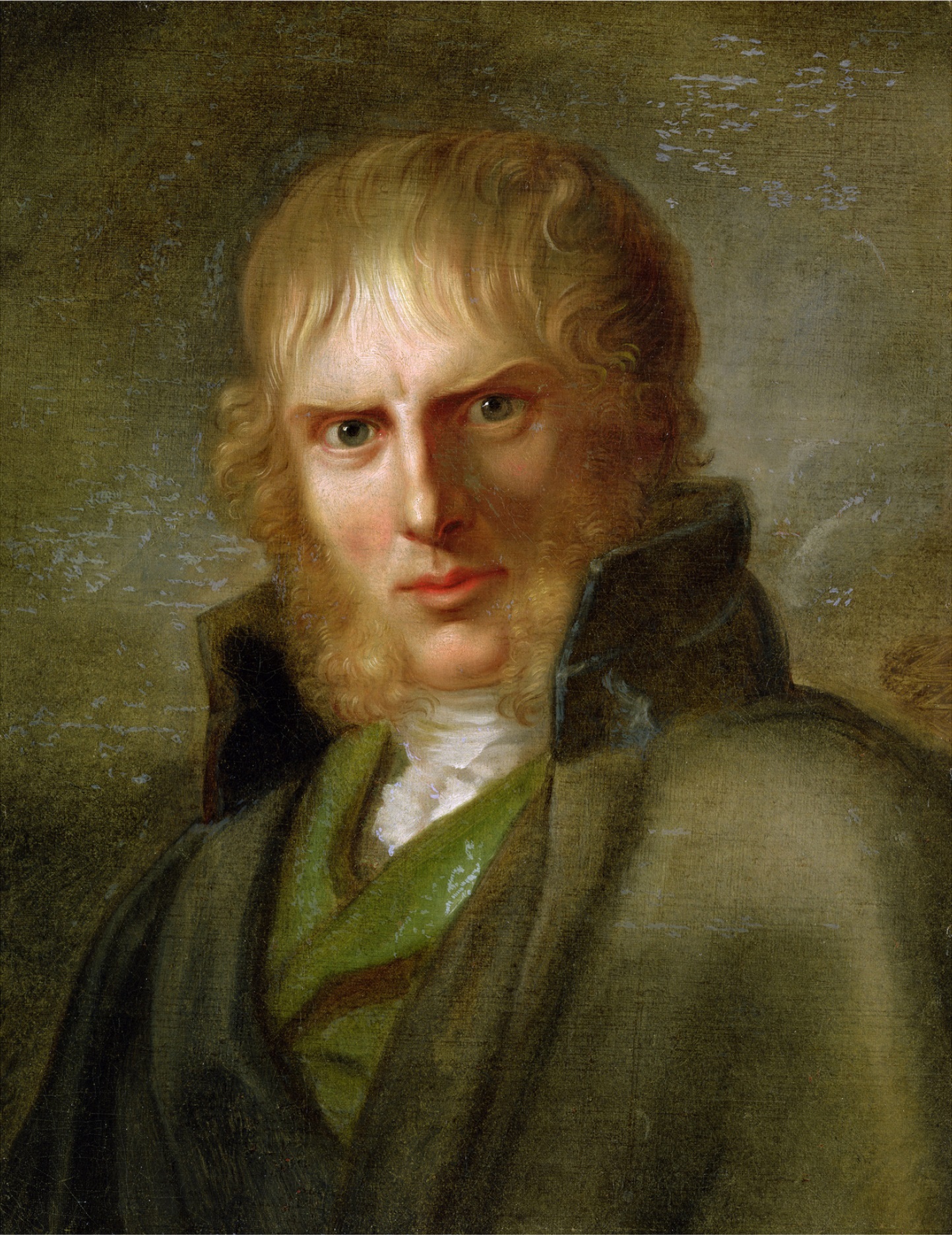
Caspar David Friedrich
September 5, 1774 - May 7, 1840
One of the central figures of German Romanticism

Seashore with Shipwreck by Moonlight
(1825-1830)

Portrait of Caspar David Friedrich, c. 1810-20
by Gerhard von Kügelgen (1772-1820)
This Dude was intense.
I recently discovered the painting The Sea Of Ice, which I've also seen translated as Shipwreck (Polar Sea).
The image was a part of my daily visual landscape for about a week before I realized it was a painting. My glance had been reading it as a contemporary installation, some kind of set. A dramatic, other-worldly scene. -- As a painting it is a very different animal, and as a painting created in the 1820's... it blows my mind. The sensibility seems so contemporary: The solidity, geometry, broken bits, jagged edges.
Analogy
"Analogia, or ana/logos, signifies 'according to due ratio' and 'according to the same kind of way.' Analogon, then is the proportion or similarity that exists between two or more apparently dissimilar things: like the tensile harmony that Parmenides maintained fitted together fire and earth, or Empedocles believed conjoined love and hate, or Anaxogoras thought tied the visible to the invisible realm. Both ancient and modern, its figures of reconciliation expressed how self could relate to others, how human beings might exist in reciprocity with society or in harmony with nature.
With Plato, Aristotle, the Neoplatonists, Aquinas, Kant, Mill, Nietzsche, Heidegger, and the late Wittgenstein, this elastic knot of unity assumed a wider epistemological meaning than numerical equidistance and logical symmetry. It emerged as a form of dialectics attempting to bridge the seen and the unseen, the known and the unknown. Proportionality, or the like and reciprocal relation between two proportions, is distinct from mere identity, the illusion of full adequacy in the explication of one term by means of another."
-Barbara Maria Stafford, Visual Analogy, p8
Elective Affinities
by Johann Wolfgang von Goethe
- Barbara Maria Stafford, Visual Analogy, p19
Wednesday, July 8, 2009
Sunday, July 5, 2009
Sunday, June 28, 2009
Thursday, June 25, 2009
Saturday, June 20, 2009
Thursday, June 18, 2009
Wednesday, June 17, 2009
Tuesday, June 16, 2009
Obama Trading Cards


I can't decide whether I think these are worrisome or awesome.
All this reading I've been doing lately about images... how we are encouraged to live in a world of shadows, consuming; acting in a commercial/image realm and equating that with having an actual affect on 'real' life...
And then there is Ranciere's notion of the 'distribuition of the sensible' which proposes that by changing our images we are indeed changing the world: A change in what is visible catalyzes a change in what is imaginable and acceptable, this allows for new social configurations and dynamics.
What does it mean to commemorate (co-memorate—as in: creating memories together) history commercially? Topps has marketed other historic series' such as President Kennedy cards and 'Man on the Moon' cards in the 1960's.
In this way one can 'own' a part of history. But don't we already own a part of this history? Don't we own it because we participated in it? Does owning it as an image, as something outside of ourselves, eclipse our sense of personal involvement in it from experience?
Whatever Obama trading cards mean, I have to admit, I like 'em and I kinda want some...
get your own at Topps
Monday, June 15, 2009
The Devil's Hangout
Yes, sir, I said.
No, don't agree too quick, Bliss; wait until you understand. But like old Luke says, "The light of the body is the eye," so you want to be careful that the light that your eye lets into you isn't the light of darkness. I mean you always have to be sure that you see what you're looking at.
I nodded my head, watching his eyes. I could see him studying the Word as he talked.
That's right, he said, many times you will have to preach goodness out of badness, little boy. Yes, and hope out of hopelessness. God made the world and gave it a chance, and when it's bad we have to remember that it's still his plan for it to be redeemed through the striving of a few good women and men. So come on, we're going to walk down there and take us a good look. We're going to do it in style too, with some popcorn and peanuts and some Cracker Jacks and candy bars. You might as well get some idea of what you will have to fight against, because I don't believe you can really lead folks if you never have to face up to any of the temptations they face. Christ had to put on the flesh, Bliss: you understand? And I was a sinner man too.
Yes, sir.
But wait here a second, Bliss—
He looked deep into me and I felt a tremor. Sir? I said.
His eyes became sad as he hesitated, then:
Now don't think this is going to become a habit, Bliss. I know you're going to like being in there looking in the dark, even though you have to climb up those filthy pissy stairs to get there. Oh yes, you're going to enjoy looking at the pictures just about like I used to enjoy being up there on the bandstand playing music for folks to enjoy themselves to back there in my olden days. Yes, you're going to like looking at the pictures, most likely you're going to be bug-eyed with the excitement; but I'm telling you right now that it's one of those pleasures we preachers have to leave to other folks. And I'll tell you why, little preacher: Too much looking at those pictures is going to have a lot of folks raising a crop of confusion. The show hasn't been here but a short while but I can see it coming already. Because folks are getting themselves mixed up with those shadows spread out against the wall, with people that are no more than some smoke drifting up from hell or pouring out of a bottle. so they lose touch with who they're supposed to be, Bliss. They forget to be what the Book tells them they were meant to be—and that's God's own image. The preacher's job, his main job, Bliss, is to help folks find themselves and to keep reminding them to remember who they are. So you see, those pictures can go against our purpose. If they look at those shows too often they'll get all mixed up with so many of those shadows that they'll lose their way. They won't know who they are is what I mean. So you see, if we start going to the picture-show all the time, folks will think we're going to the devil and backsliding from what we preach. We have to set them an example, Bliss; so we're going in there for the first and last time—
-from Juneteenth, by Ralph Ellison
A capitalist society needs...
A capitalist society requires a culture based on images. It needs to furnish vast amounts of entertainment in order to stimulate buying and anesthetize the injuries of class, race, and sex. And it needs to gather unlimited resources, increase productivity, keep order, make war, give jobs to bureaucrats. The camera's twin capacities, to subjectivize reality and to objectify it, ideally serve these needs and strengthen them. Cameras define reality in the two ways essential to the workings of an advanced industrial society: as a spectacle (for masses) and as an object of surveillance (for rulers). The change is replaced by a change in images. The freedom to consume a plurality of images and goods is equated with freedom itself. The narrowing of free political choice to free economic consumption requires the unlimited production and consumption of images.
-Susan Sontag, On Photography, p178-179
Friday, June 12, 2009
Found Art Installation
Fenced-off Lot
Potrero Ave. & Mariposa
Clearly intentional,
Note the aerosol shadow that the tree throws- down the wall, across
the cement...
Did the same mind join the tree to the pipe?
I don't think so
These are different sensibilities
One is changing, connecting, inserting, disturbing, lifting
The other is commenting, noticing, tracing, projecting
One is the sun, active
The other the shadow, receptive
Potrero Ave. & Mariposa
Clearly intentional,
Note the aerosol shadow that the tree throws- down the wall, across
the cement...
Did the same mind join the tree to the pipe?
I don't think so
These are different sensibilities
One is changing, connecting, inserting, disturbing, lifting
The other is commenting, noticing, tracing, projecting
One is the sun, active
The other the shadow, receptive
Construction
Bryant, between 24th & 25th
I've been really drawn to construction sites lately.
The colors, I love the bright orange,
but also the equipment,
I have the awe of a 6-year-old boy all of a sudden
And the digging and breaking and the working together
The changing of the city
The changing of a street
These crews come in and they change our physical world!
These orange colored crews
I've been really drawn to construction sites lately.
The colors, I love the bright orange,
but also the equipment,
I have the awe of a 6-year-old boy all of a sudden
And the digging and breaking and the working together
The changing of the city
The changing of a street
These crews come in and they change our physical world!
These orange colored crews
Thursday, June 11, 2009
A Sign
I just like the way this looks
The contrast of the two signs
The one, nicely typed and formatted
The other, official in a different way, functional
One, professional
The other, working class
Two different signs from two different worlds placed side by side
equal in their necessariness
Wednesday, June 10, 2009
Monday, June 8, 2009
...nothing that should not be seen...
"According to one attitude, there is nothing that should not be seen; according to the other, there is nothing that should not be recorded. Cameras implement an aesthetic view of reality by being a machine-toy that extends to everyone the possibility of making disinterested judgments about importance, interest, beauty. ("That would make a good picture.") Cameras implement the instrumental view of reality by gathering information that enables us to make a more accurate and much quicker response to whatever is going on. The response may of course be either repressive or benevolent: military reconnaissance photographs help snuff out lives, X-rays help save them."
- On Photography - p176
Excerpts from 'On Photography'
by Susan Sontag
published in 1973
p156
"While many people in the non-industrialized countries still feel apprehensive when being photographed, divining it to be some kind of trespass, an act of disrespect, a sublimated looting of personality or the culture, people in industrialized countries seek to have their photographs taken—feel that they are images, and are made real by photographs."
p161
"To possess the world in the form of images is, precisely, to reexperience the unreality and remoteness of the real."
p164
Tuesday, June 2, 2009
Zen in the Art of Photography
"Cartier-Bresson has likened himself to a Zen archer (see my post on 'Zen in the Art of Archery'), who must become the target so as to be able to hit it; 'thinking should be done
beforehand and afterwards,' he says, 'never while actually taking a
photograph.'"
beforehand and afterwards,' he says, 'never while actually taking a
photograph.'"
-'On Photography' by Susan Sontag
Sunday, May 31, 2009
Subscribe to:
Posts (Atom)